Monday, January 7, 2013
Artist Emulation: Edward Hopper
A lot of Edward Hopper's work involves using both naturalistic and industrial objects as the subject matters of his paintings. For his industrial objects, he usually tended to use objects or scenes that were known to represent modernity in his lifetime--such as movie theaters, lighthouses, cafés, gas stations, and street corners. He also incorporated naturalistic components into his work alongside the modern components, which to many were interpreted as a way of communicating the ways that society was imposing itself upon the natural world. In this way, Hopper was able to convey deeper themes and messages in his work, giving it a more personal feel and giving Hopper a more meaningful objective as an artist. According to my research on Hopper, I learned that he often created sketches and outlines of his drawings before starting on his final (painted) work. These sketches were usually done using a pen, pencil, or ink, and conveyed a rough sense of what the final project would include and how it would be laid out. He did this as a practice routine in order to prepare for creating the final work.

Monday, November 26, 2012
Painting Strip Project
 |
| Original Painting: Monet, Houses of Parliament |
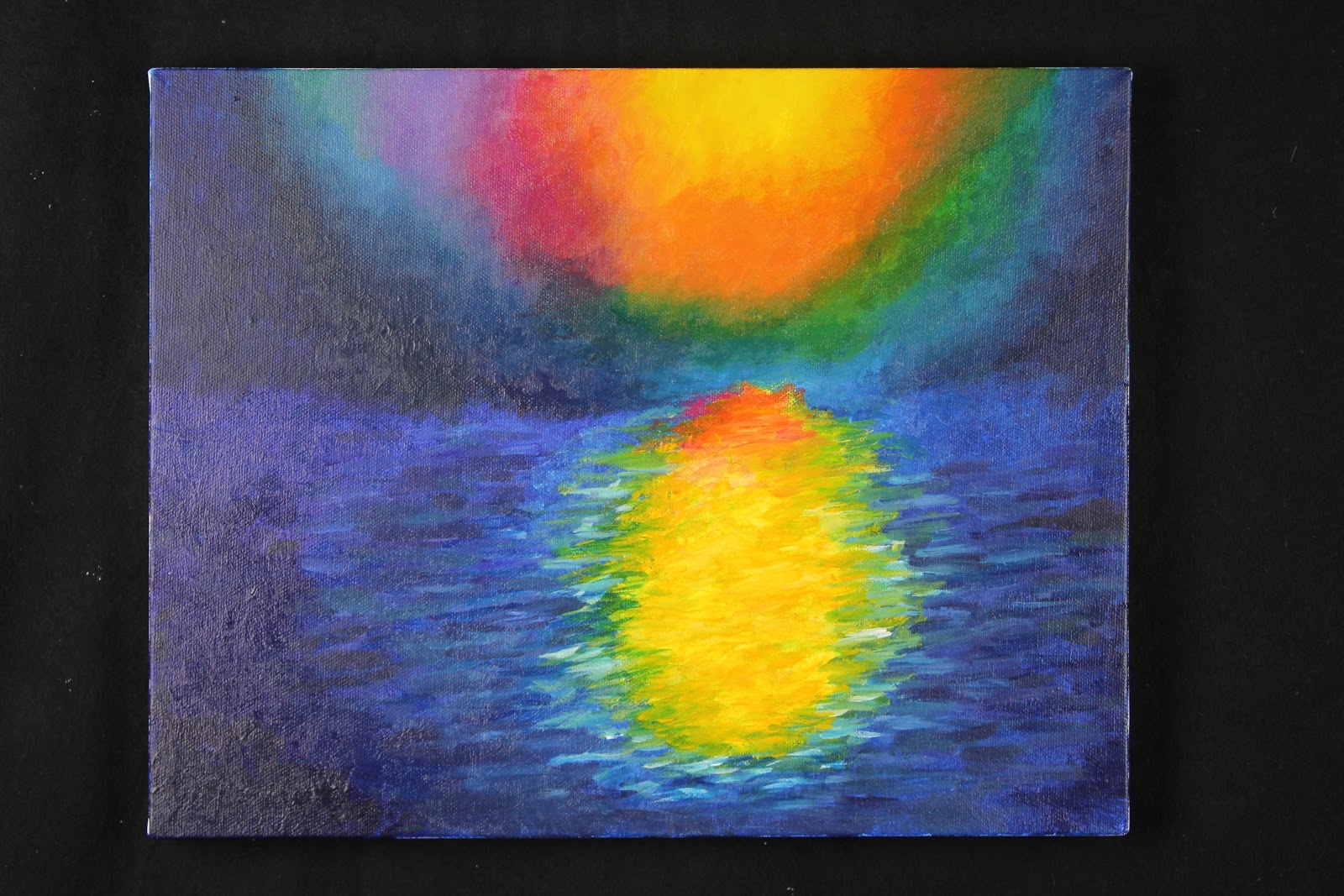
I think that my work shows an understanding of the style and mark making of the original strip because the brush strokes appear to be pretty similar, and my final painting resembles the strip pretty accurately. I tried to differentiate the areas of my painting where there were actual brush strokes that stood out individually from areas with blotting/mixing of the colors on the canvas, where there were less clear individual marks. I also did my best to replicate the colors of my original strip in my painting, by closely comparing the different shades of all of the colors that I used with the strip in order to make sure they were as similar as possible. Through the process of this project, I learned that it takes a lot of time and patience to create exactly the color you want, especially if you have a specific hue in mind that you are trying to match it with. Along these same lines, I also learned that it is extremely difficult to replicate a color that is already on your canvas if it had dried previously and is no longer on your palette to work with. I believe that my final canvas is extremely unified. I started out paying more attention to the center area with the sun and its reflection on the water, and put a lot of effort into perfecting the brush strokes and colors I used. However, after I had spent a lot of time on that one area, I realized that it was disproportional to the rest of the painting, so I then spent more time on the other areas of the painting, and concentrated on improving the brush strokes and colors I had used there. After this project, I feel very comfortable as a painter. I enjoy being able to create colors and manipulate them into exactly what I want, and I think that I have developed this skill through this project. I would be interested in further exploring this medium by painting in different styles, and experimenting with different subjects. One of the limitations that this medium poses for me is the issue of communicating space and distance––since it is a 2-dimensional painting, it is sometimes difficult to perfectly represent a 3-dimensional object, which I will have to work on in order to improve my painting techniques.
Monday, October 15, 2012
Learning to See: Final Blog Post


Monday, October 1, 2012
Line/Silhouette Drawings: Intentions


In the next few days as we create more sketches, I will focus on trying to bring together the elements of silhouette and line quality in order to produce a more complex, realistic sketch or design. For example, when I was beginning to draw a large tree trunk, I started by creating an outline of the basic shape of the trunk, and then I sort of filled it in with the most heavy lines that I saw in the bark of the tree. This produced an outline of the most basic marks on the trunk, which I liked because it wasn't a completely detailed drawing, but it still got the idea across and represented the tree trunk in its most basic form. I will also try to use the thickness/thinness of the lines that I draw in order to design shadows and highlights in my sketches.
Friday, September 21, 2012

Thursday, September 6, 2012
Contour Line Drawings Reflection
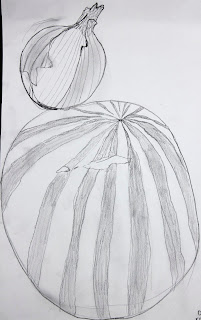
In my contour drawings, I think that I was able to pretty thoroughly explore the expressive qualities of line. Especially in my ink and water drawing, I tried to experiment with the thinness/thickness of my lines, as well as the darkness/lightness of the lines. I tried to put emphasis on lines that stood out to me when I looked at the object––especially shadows. I am pretty happy with the effect that this technique had on the end result of my drawing, because it made the oil can look more realistic and highlighted the parts of it that were highlighted in real life when I looked at the actual object itself. I felt really comfortable with the ink and water drawing, because I liked how it was pretty easy to manipulate the line in so many different ways with the brush I was using. This made it easier to create a drawing that really accurately represented the object. I also enjoyed that I had a lot of freedom to express the objects however I wanted, in order to convey a certain feeling or attitude to the viewer. I think that one of my strengths as a representational artist is my line quality, because I tried to put a lot of effort into how my lines came across on the paper, in order to understand exactly how a viewer might perceive my drawings.


Monday, June 4, 2012
Final Art Reflection
1. I believe that my two most successful works from this school year have been my texture sculpture and my gesture sculpture. My texture sculpture included rocks, toothpicks, feathers and cloth glued onto a wooden board, and my gesture sculpture was made out of hardened plaster.

 |

2. My texture sculpture stands out to me because I think that I did a good job of conveying texture to the viewer. As opposed to my drawing of textures, I think that this sculpture did a nice job of separating the textures from the objects that they are attached to, so that when the viewer sees the sculpture, the eye and brain are drawn not to the actual object that was glued down to the board, but to the textures contained in the objects. This was really the goal of the project--create a sculpture that highlights textures, not objects--and I think that I achieved this goal, which is why I think it was such a successful work for me. I especially think that I grew in my capacity to envision and express in this project, because in order for my sculpture to be successful I had to first envision what I wanted the outcome to be, and I had to figure out a way to express my vision to others via the materials I was given. For my gesture sculpture, I think that it was very successful, because I captured the gesture of the figure, but did not focus so much on the human figure itself. I spent a while trying to think of a way to create a sculpture that exemplified a specific gesture more than a general figure, and had to practice the "engage and persist" habit of mind in order to finally reach my goal and come up with this design.
3. I think that my least successful work was my texture collages. I really struggled with how to express textures through a digital medium, and it was hard for me to find a way to be successful with that. However, by doing other projects with texture (like the sculptures), I was able to learn from my mistakes with the digital form, and I think that I would be able to do a better job now.
4. I think that expressing and envisioning are my greatest strengths. It comes pretty naturally to me to visualize how I want a piece of art to turn out, and then I have to use my skills of expression in order to make that vision come to life on the canvas, in the photo, etc. They kind of go hand in hand, because without one you cannot really go anywhere with the other.
5. I think that I definitely gave it my all in most areas of this class--I have always loved art, and it's really fun for me and a nice way to relax sometimes. I have always tried my best with the given assignments, and done whatever I can to meet my goals. I know that sometimes I can get distracted in the classroom, but I am working on that and I think that I have improved.
6. I'm just excited to continue art class next year––I know that there are many schools without an art program available, and I feel extremely lucky to have such excellent resources at my fingertips. I look forward to continuing my passion for art, and also to receiving constructive criticism so that I can improve in my artistic abilities.
7. The skills that I have developed in the studio can definitely help me in places that are not specifically art class--just having the creative side of my brain stimulated regularly helps me concentrate in my classes, and I really enjoy having a creative outlet as a break from academic classes, which I can sometimes become stressed out over. Participating in art also allows me to have a more expansive understanding of how concepts relate to each other, and I can compare more abstract things that I otherwise could not.
Subscribe to:
Posts (Atom)